
Two-Stroke vs Four-Stroke Marine Engine Oils: What Is the Difference?
In marine operation, choosing the right lubricant is not simply a matter of selecting “diesel engine oil” or matching an SAE viscosity grade. The first and most important step is to identify the engine type: two-stroke or four-stroke.
According to the Chevron Marine Lubricants Handbook, slow-speed two-stroke crosshead engines and medium-speed four-stroke trunk piston engines require different lubrication strategies, different oil chemistry and different product categories. Using the wrong oil can increase the risk of liner wear, acidic corrosion, piston deposits, poor cleanliness, excessive oil consumption or equipment reliability issues.
1. Basic Difference Between Two-Stroke and Four-Stroke Marine Engines
Two-stroke marine engines
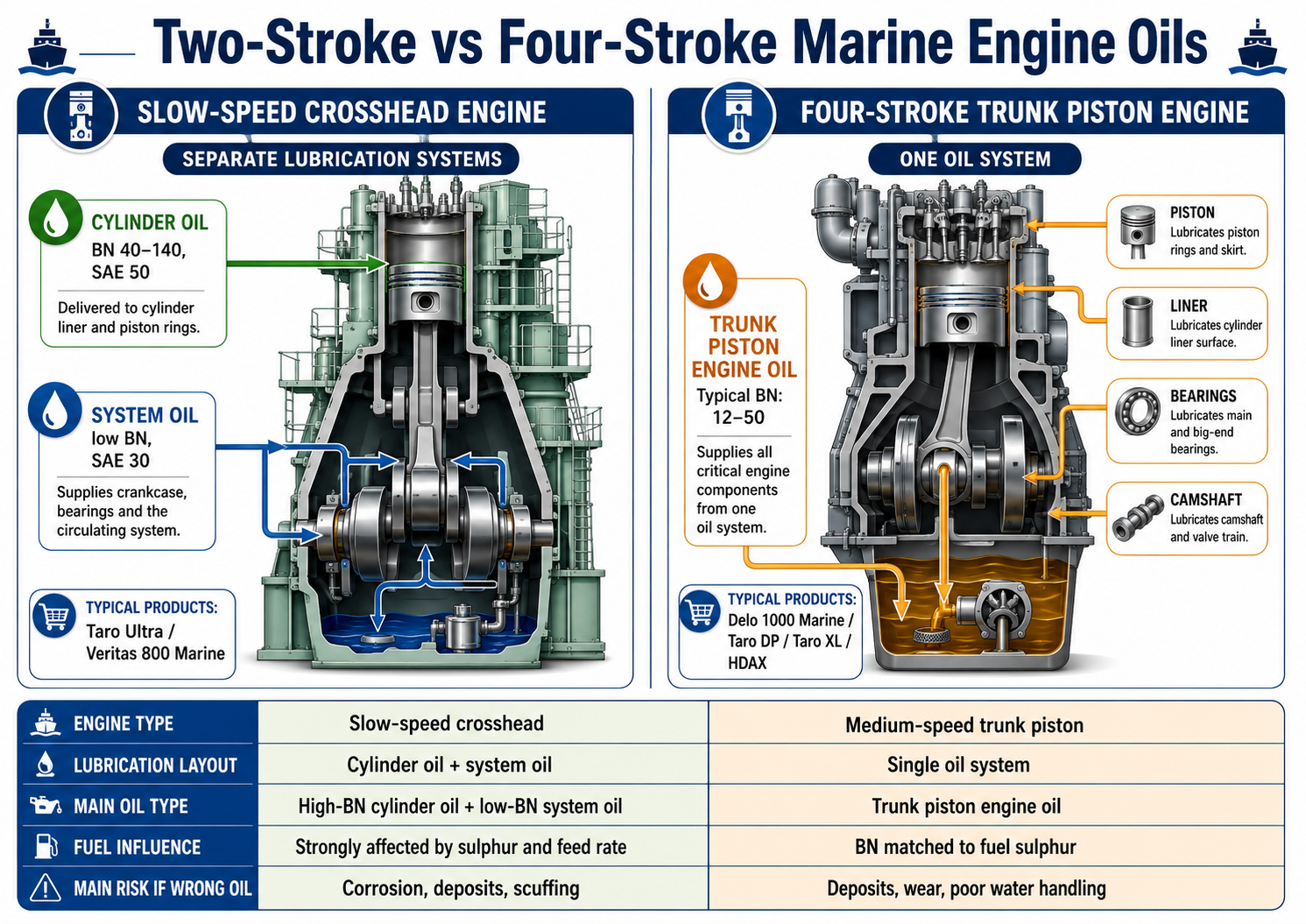
In the marine sector, two-stroke engines usually refer to large, slow-speed crosshead engines used as main propulsion engines on ocean-going vessels.
The key lubrication characteristic of this engine type is that the lubrication system is divided into two main areas:
The cylinder area, where the oil must lubricate the cylinder liner and piston rings, neutralize acidic combustion by-products and help control deposits.
The crankcase or system oil area, where the oil lubricates bearings, the running gear and the circulating oil system.
For this reason, a slow-speed two-stroke crosshead engine normally requires two different lubricant types: cylinder oil and system/crankcase oil.
Four-stroke marine engines
Four-stroke marine engines are commonly medium-speed trunk piston engines. Their lubrication system is different from that of two-stroke crosshead engines. A single engine oil typically lubricates multiple areas, including pistons, liners, bearings, camshafts and other moving components.
This type of lubricant is usually called trunk piston engine oil, or TPEO.
A four-stroke marine engine oil must balance several performance requirements at the same time: piston cleanliness, soot handling, wear protection, corrosion control, water separation, oxidation stability and viscosity control under high-temperature operation.
2. Oil for Two-Stroke Marine Engines: Cylinder Oil and System Oil Are Not the Same
For slow-speed two-stroke crosshead engines, it is essential to distinguish between cylinder oil and system oil.
Cylinder oil for two-stroke engines
Cylinder oil is injected directly into the cylinder area to lubricate the liner and piston rings. One of its most important roles is to neutralize acids formed during combustion.
When high-sulphur fuel burns, sulphur oxides can form. In the presence of water, these can create sulphuric acid, which may cause corrosive wear inside the engine. Cylinder oil helps counter this through its alkalinity, expressed as Base Number, or BN.
However, higher BN is not automatically better in every case. If alkalinity is excessive for the fuel and operating condition, abrasive deposits can form on piston crown top lands, potentially increasing liner wear and scuffing risk. Therefore, the correct BN must be selected based on fuel sulphur level, engine condition, OEM guidance and cylinder oil feed rate.
In Chevron’s marine range, Taro® Ultra products are cylinder oils for slow-speed two-stroke crosshead engines. The range covers different BN levels for different fuels and operating routes:
| Product | Main Application | BN | SAE Grade |
|---|---|---|---|
| Taro® Ultra Advanced 40 | VLSFO, MGO/MDO, LNG/LPG and methanol; designed for Category II performance requirements | 40 | SAE 50 |
| Taro® Ultra 40 | Low-sulphur fuels, VLSFO, MGO/MDO, methanol and intermittent distillate operation | 40 | SAE 50 |
| Taro® Ultra 70 | Wide fuel range | 70 | SAE 50 |
| Taro® Ultra 100 | HSHFO with scrubbers; optimized to help combat corrosion | 100 | SAE 50 |
| Taro® Ultra 140 | HSHFO with scrubbers; optimized to help combat cold corrosion and support feed rate optimization | 140 | SAE 50 |
The key point is that two-stroke cylinder oil should be selected according to fuel type, sulphur level, OEM requirements, engine condition and feed rate strategy, not simply by viscosity grade.
System oil for two-stroke engines
A two-stroke crosshead engine also needs system oil for the crankcase and circulating oil system. In the Chevron range, Veritas® 800 Marine 30 and Veritas® 800A Marine 30 are crankcase oils for slow-speed two-stroke crosshead engines.
These oils have much lower BN than cylinder oils. For example, Veritas® 800 Marine 30 is listed as a two-stroke slow-speed engine system oil with BN 5.6 and SAE 30. Its role is to provide crankcase lubrication, anti-corrosion performance, anti-foam properties and reliable protection for the circulating oil system.
In simple terms:
Cylinder oil cannot replace system oil. System oil cannot replace cylinder oil.
They are designed for different areas of the engine and different lubrication mechanisms.
3. Oil for Four-Stroke Marine Engines: Multi-Function Trunk Piston Engine Oil
For medium-speed four-stroke trunk piston engines, the lubricant must perform several tasks within one oil system. It must lubricate piston and liner areas, protect bearings and camshafts, control soot, manage contamination and help maintain engine cleanliness.
The Chevron Marine Lubricants Handbook lists several product families for medium-speed four-stroke engines, including Delo® 1000 Marine, Taro® DP/XL Series and HDAX® for gas or dual-fuel applications.
Delo® 1000 Marine for medium-speed engines
Delo® 1000 Marine is a medium-speed marine engine oil designed for trunk piston diesel engines. It is available in SAE 30 and SAE 40, with BN 12. The Handbook lists it for MGO/MDO use and fuel sulphur levels up to 1.5%.
This type of oil is designed to support viscosity control, BN retention, piston cleanliness, soot handling and water tolerance in marine operation.
Taro® DP and Taro® XL for higher sulphur fuels
For medium-speed four-stroke engines operating on fuels with higher sulphur content, Chevron lists Taro® 20 DP, Taro® 30 DP, Taro® 40 XL and Taro® 50 XL.
These oils provide higher BN levels and are matched to different fuel sulphur ranges.
| Product | SAE Grade | BN | Reference Fuel Sulphur Level |
|---|---|---|---|
| Delo® 1000 Marine 30/40 | SAE 30 / SAE 40 | 12 | Up to 1.5% |
| Taro® 20 DP 30/40 | SAE 30 / SAE 40 | 20 | Up to 2% |
| Taro® 30 DP 30/40 | SAE 30 / SAE 40 | 30 | Up to 4% |
| Taro® 40 XL 40 | SAE 40 | 40 | Up to 4.5% |
| Taro® 50 XL 40 | SAE 40 | 50 | Up to 4.5%; suitable where natural engine oil consumption is low |
This shows that four-stroke engine oil selection depends not only on SAE 30 or SAE 40, but also on BN, fuel sulphur level, OEM approval and actual operating condition.
HDAX® for LNG and dual-fuel engines
Not every four-stroke marine engine operates only on conventional diesel fuel. With LNG and dual-fuel operation becoming more common, Chevron also includes HDAX® gas engine oils in its marine range.
For example, HDAX® 9700 SAE 40 is listed for LNG and MGO/MDO applications, while HDAX® 5200 SAE 40 is listed for LNG applications. These oils are designed for gas or dual-fuel engines where ash control, deposit control, corrosion protection and engine cleanliness are critical.
4. Quick Comparison: Two-Stroke vs Four-Stroke Marine Engine Oils
| Criteria | Two-Stroke Slow-Speed Crosshead Engines | Four-Stroke Medium-Speed Trunk Piston Engines |
|---|---|---|
| Common application | Main propulsion engine on large ocean-going vessels | Main engine, auxiliary engine, generator engine or dual-fuel engine |
| Lubrication structure | Separate cylinder oil and system oil | One trunk piston engine oil system |
| Main lubricant types | Taro® Ultra cylinder oils and Veritas® 800 Marine system oils | Delo® 1000 Marine, Taro® DP/XL Series and HDAX® |
| Typical BN approach | Cylinder oils range widely from BN 40 to BN 140; system oils have low BN | BN varies by fuel sulphur level, for example 12, 20, 30, 40 or 50 |
| Key lubricant function | Acid neutralization, cold corrosion control, liner and piston ring protection, deposit control | Piston cleanliness, soot handling, wear protection, corrosion control and water separation |
| Main risk of wrong oil | Corrosive wear, abrasive deposits, scuffing, liner wear and poor feed rate control | Deposit formation, viscosity increase, poor water handling, wear and reduced oil life |
5. Common Mistakes When Selecting Marine Engine Oil
Mistake 1: Assuming the same SAE grade means the oils are interchangeable
SAE viscosity only indicates viscosity classification. It does not define additive chemistry, BN level, detergency, dispersancy, corrosion control or suitability for a specific engine design.
A two-stroke SAE 50 cylinder oil is not equivalent to a four-stroke SAE 40 trunk piston engine oil.
Mistake 2: Thinking higher BN is always better
BN is essential for neutralizing acids, especially when sulphur-containing fuels are used. But excessive alkalinity can contribute to abrasive deposits if it is not matched to the fuel, feed rate and engine condition.
The correct objective is not “highest BN”, but the right sulphur/base balance.
Mistake 3: Using four-stroke engine oil in a two-stroke crosshead engine
A trunk piston engine oil is designed for a different lubrication system. A two-stroke crosshead engine requires dedicated cylinder oil and dedicated system oil. Replacing one with the other can create serious performance and protection risks.
Mistake 4: Selecting oil without checking OEM guidance
Chevron repeatedly notes that the selected product should be consistent with the original equipment manufacturer’s recommendation for the equipment, operating conditions and maintenance practices. This is especially important for modern engines, VLSFO operation, LNG, methanol, dual-fuel operation and scrubber-equipped vessels.
6. How to Choose the Right Oil for Each Engine Type
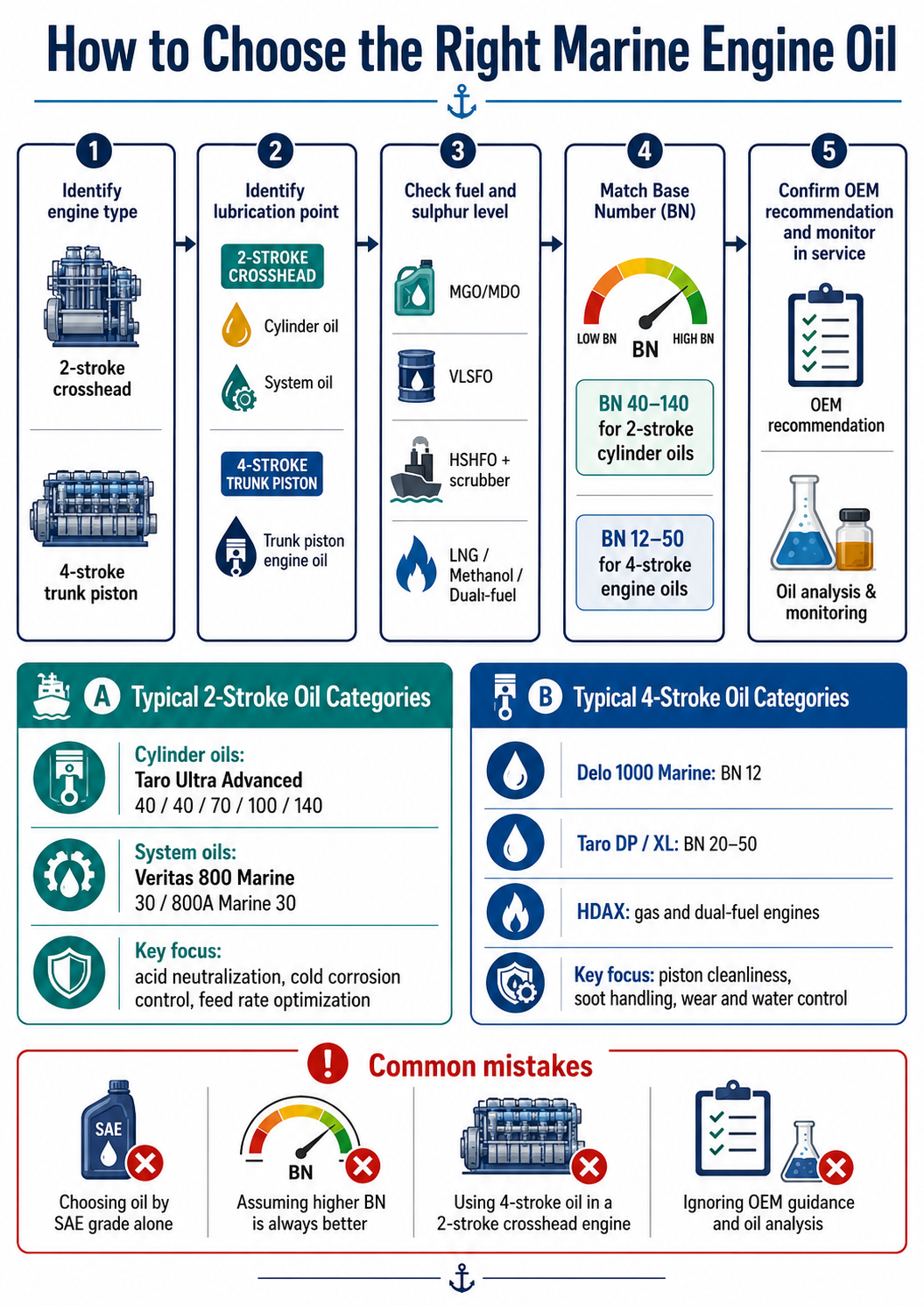
Step 1: Identify the engine type
Is it a slow-speed two-stroke crosshead engine or a medium-speed four-stroke trunk piston engine? This determines the lubricant category.
Step 2: Identify the lubrication point
For a two-stroke engine, separate the requirement into cylinder oil and system oil. For a four-stroke engine, select the correct trunk piston engine oil.
Step 3: Confirm the fuel type and sulphur level
MGO/MDO, VLSFO, HSHFO with scrubber, LNG, methanol and dual-fuel operation all create different lubricant requirements.
Step 4: Check OEM requirements
Always verify the product against the engine maker’s latest recommendations and approvals.
Step 5: Monitor lubricant condition in service
Oil analysis, drip oil analysis, iron measurement, BN monitoring, viscosity checks and inspection results help operators optimize feed rate and detect abnormal wear or corrosion early.
FAQ
What oil is used in two-stroke marine engines?
Slow-speed two-stroke crosshead engines typically use cylinder oil for the cylinder liner and piston ring area, and system oil for the crankcase and circulating oil system. In Chevron’s range, Taro® Ultra products are cylinder oils, while Veritas® 800 Marine products are system oils.
What oil is used in four-stroke marine engines?
Medium-speed four-stroke trunk piston engines generally use trunk piston engine oils such as Delo® 1000 Marine, Taro® DP/XL Series or HDAX®, depending on the fuel type, sulphur level and engine requirements.
Can two-stroke cylinder oil be used in a four-stroke engine?
No. Two-stroke cylinder oils and four-stroke trunk piston engine oils are designed for different lubrication systems and different operating conditions. Using the wrong oil can lead to incorrect BN balance, deposit formation, wear or poor equipment protection.
What does BN mean in marine engine oil?
BN, or Base Number, indicates the oil’s alkalinity and its ability to neutralize acids formed during combustion. The right BN depends on fuel sulphur level, engine design, feed rate and OEM guidance.
Conclusion
The main difference between oils for two-stroke and four-stroke marine engines comes from the engine design and lubrication system.
A slow-speed two-stroke crosshead engine requires separate cylinder oil and system oil. A medium-speed four-stroke trunk piston engine uses a multi-function trunk piston engine oil that protects several engine areas within one oil system.
For reliable operation, oil selection should never be based only on SAE viscosity or a general “marine diesel engine oil” description. The correct selection must consider engine type, fuel type, sulphur level, BN, OEM recommendation and real operating conditions. When these factors are properly matched, marine lubricants can help control corrosion, reduce wear, maintain cleanliness, optimize oil consumption and improve vessel reliability.


Global Marine Lubricants Company Limited
Office: 328C Phan Dinh Phung, Cau Kieu Ward, Ho Chi Minh City, Vietnam
Tax Code: 0319412061
Email: sales@lubricantmarine.com
Hotline: +84 567 977 668
Website: lubricantmarine.com


© COPYRIGHT 2026 | GLOBAL MARINE LUBRICANTS Co., LTD