
How to Choose the Right Marine Lubricant for Your Vessel
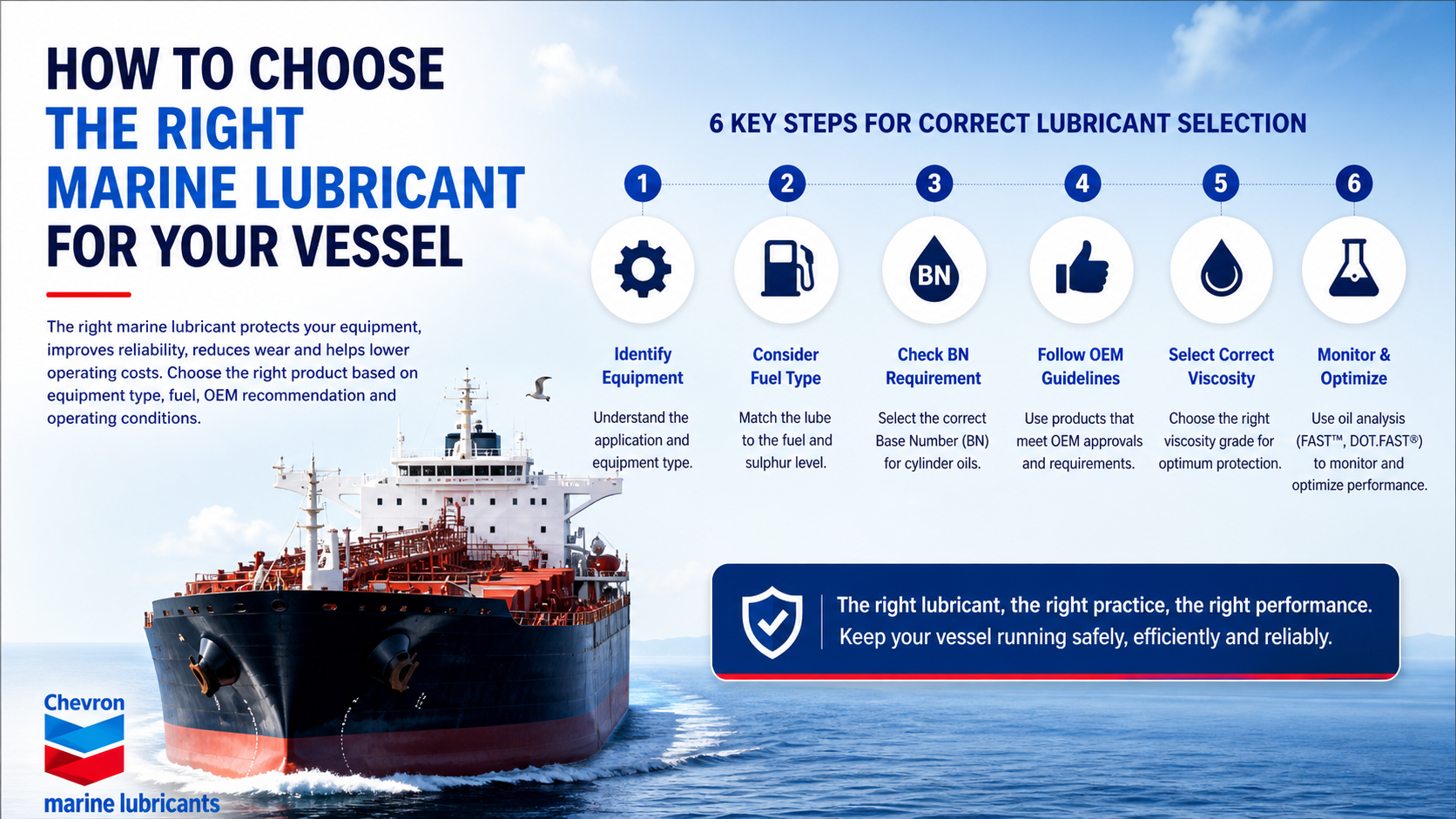
Choosing the right marine lubricant is one of the most important technical decisions for vessel reliability. A ship operates under heavy loads, long running hours, high temperatures, saltwater exposure, fuel variability and strict environmental requirements. Under these conditions, the lubricant is not just an oil — it is a protection system for the machinery that keeps the vessel moving.
The correct marine lubricant helps reduce wear, control deposits, protect against corrosion, support heat transfer, extend equipment life and reduce unplanned downtime. The wrong lubricant, however, can lead to excessive wear, poor engine cleanliness, corrosion, oil degradation, filter blockage, overheating or even major mechanical failure.
Chevron Marine Lubricants emphasizes that product selection should always be consistent with the Original Equipment Manufacturer’s recommendation, equipment operating conditions and customer maintenance practices. The handbook also shows that fuel type, engine design, application and technical monitoring all play a major role in selecting the right lubricant.
Why Marine Lubricant Selection Matters
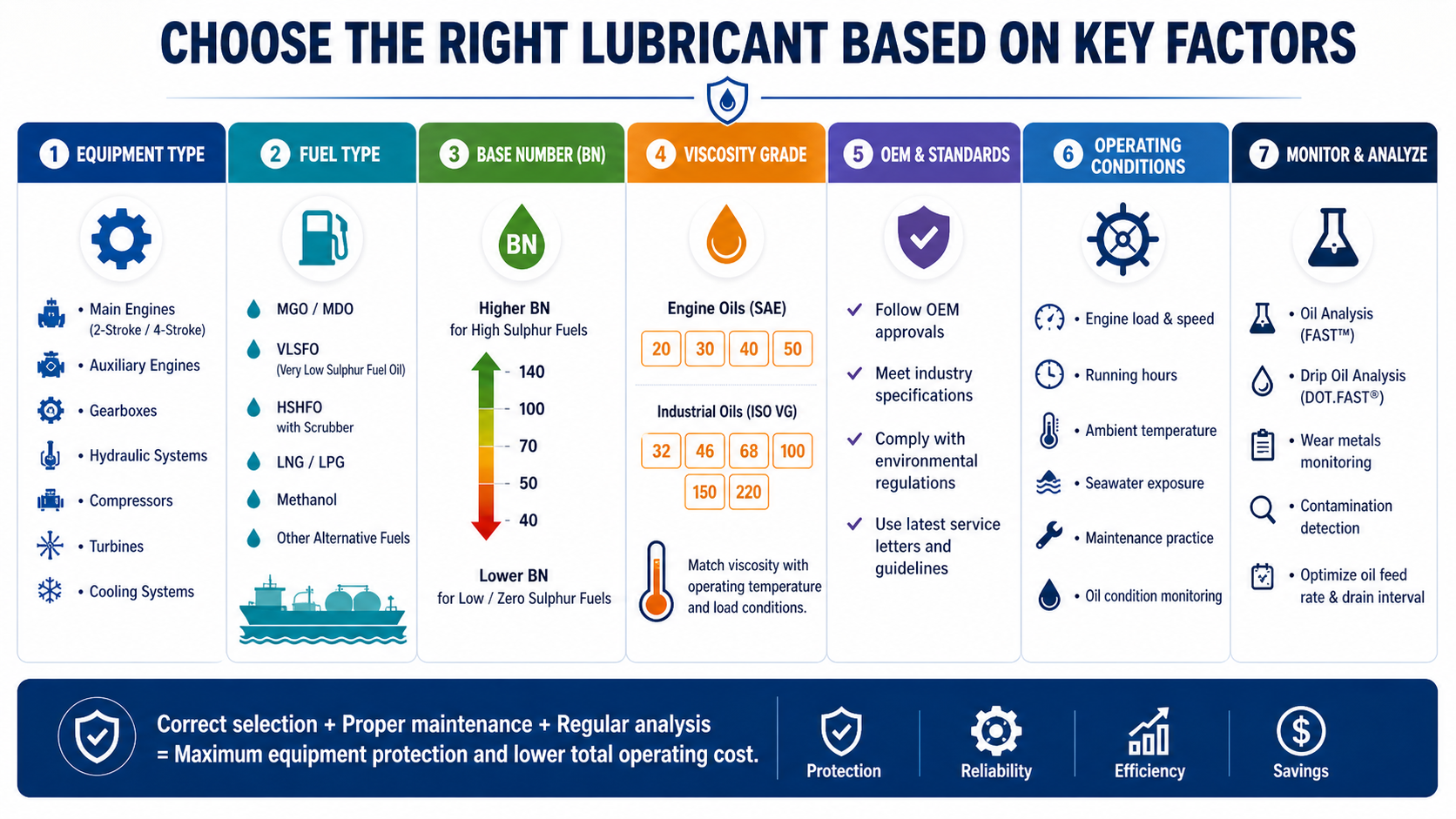
Marine equipment is exposed to harsher operating conditions than many land-based machines. A vessel may run continuously for weeks, switch fuel types between voyages, operate in different climates and rely on onboard crews to maintain machinery while far from shore.
A good lubricant must perform several technical functions at the same time:
It must create a strong oil film between moving metal surfaces.
It must reduce friction and mechanical wear.
It must help neutralize acidic combustion by-products.
It must protect against rust, corrosion and oxidation.
It must keep pistons, rings, liners, bearings and gear surfaces clean.
It must maintain viscosity under temperature and load changes.
It must support longer oil drain intervals and predictable maintenance.
Because different onboard systems have different operating conditions, there is no single lubricant that is correct for every application. The right choice depends on where the lubricant is used, what fuel the vessel burns, what equipment manufacturer recommends and how the vessel is operated.
1. Start with the Equipment Type
The first step is to identify the equipment that needs lubrication. Each system has a different lubricant requirement.
Main Engines
Main engines are usually the most critical equipment onboard. For slow-speed two-stroke crosshead engines, operators generally need two different lubricant types: cylinder oil and system oil.
Cylinder oil protects the cylinder liner, piston rings and combustion chamber area. It must provide wear protection, piston cleanliness and acid neutralization.
System oil, also called crankcase oil, lubricates bearings and other circulating components in the engine.
For medium-speed four-stroke trunk piston engines, the lubricant must protect the crankcase, pistons, liners, bearings and valve train while also handling combustion by-products.
Auxiliary Engines
Auxiliary engines power generators and other onboard systems. They often operate under variable loads, making oil cleanliness, soot handling, oxidation resistance and BN retention important.
Gearboxes
Marine gearboxes are exposed to high loads, shock loading, water contamination and high operating temperatures. A suitable marine gear oil must provide extreme pressure protection, anti-wear performance, oxidation stability, foam control and water separation.
Hydraulic Systems
Hydraulic systems are used in steering gear, cranes, hatch covers, winches and control equipment. Hydraulic oils must maintain stable viscosity, protect against wear and resist oxidation, especially when the system operates under pressure or is exposed to contamination.
Compressors
Compressor oils must resist carbon deposit formation, oxidation and high-temperature stress. In marine compressors, the wrong oil can lead to valve deposits, reduced efficiency and increased maintenance.
Cooling Systems
Cooling water treatment is not a traditional lubricant, but it is part of the vessel’s fluid protection program. Cooling system fluids help prevent corrosion, cavitation, scale and heat transfer problems.
2. Match the Lubricant to the Fuel Type
Fuel type is one of the most important factors in marine lubricant selection. Modern vessels may operate on several fuel options, including:
MGO or MDO, also known as Marine Gas Oil or Marine Diesel Oil.
VLSFO, or Very Low Sulphur Fuel Oil.
HSHFO used with scrubbers.
LNG or LPG.
Methanol and other alternative fuels.
Each fuel type creates different lubrication challenges. High sulphur fuels generate more acidic combustion products, which require stronger acid neutralization. Low sulphur fuels reduce the acid load but may create other challenges related to deposits, cleanliness and cylinder condition. LNG and methanol applications may require specialized lubricant strategies because combustion chemistry and operating conditions differ from conventional fuel oil.
For this reason, marine lubricant selection should always consider the vessel’s present and future fuel strategy.
3. Understand Base Number, or BN
Base Number, commonly called BN, is especially important for marine cylinder oils. BN measures the alkaline reserve of the lubricant. This reserve helps neutralize acidic compounds formed during fuel combustion.
In simple terms:
Higher sulphur fuel usually requires higher BN protection.
Lower sulphur fuel usually requires lower or moderated BN.
Using too low a BN can increase corrosion risk.
Using too high a BN in the wrong operating condition can contribute to deposits and ash-related issues.
Chevron’s Taro® Ultra cylinder oil range includes different BN options to support various fuel conditions. The handbook describes Taro Ultra products ranging from BN 40 to BN 140 for compatibility with fuel types from low or zero sulphur fuels to high sulphur fuels used with exhaust gas abatement systems.
This is why BN selection should not be based on habit. It should be based on fuel sulphur level, engine design, OEM guidance, inspection results and oil analysis.
4. Check OEM Approvals and Recommendations
OEM approval is a critical selection factor. Marine engines and equipment are designed with specific lubrication requirements. These may include viscosity grade, performance standard, approved product list, BN recommendation, oil feed rate guidance and changeover procedures.
A lubricant may look suitable on paper, but if it does not meet the relevant OEM requirements, it may create technical or warranty risks.
Before selecting any marine lubricant, operators should check:
The equipment manual.
The latest OEM service letters or recommendations.
The approved lubricant list.
The correct viscosity grade.
The correct BN or performance category.
The required oil feed rate range.
Any specific requirements for fuel transition, scrubber operation or alternative fuels.
5. Select the Correct Viscosity Grade
Viscosity is the lubricant’s resistance to flow. It affects oil film strength, pumpability, heat transfer and wear protection.
If viscosity is too low, the oil film may not be strong enough to protect moving parts.
If viscosity is too high, the lubricant may create excessive drag, poor circulation, higher operating temperature and reduced efficiency.
Marine lubricants may use SAE grades for engine oils and ISO VG grades for industrial oils such as gear oils, hydraulic oils, compressor oils and turbine oils.
For example, a gearbox may require an ISO VG gear oil, while a marine diesel engine may require an SAE engine oil. The correct viscosity must always match the equipment design, operating temperature and OEM recommendation.
6. Consider Operating Conditions
Two vessels with similar engines may still need different lubrication strategies because their operating conditions are not identical.
Important operating factors include:
Engine load profile.
Running hours.
Fuel quality and sulphur level.
Ambient temperature.
Seawater exposure.
Port-to-port operating pattern.
Maintenance schedule.
Oil consumption rate.
Condition of the engine or equipment.
Presence of scrubbers or alternative fuel systems.
For example, a vessel operating continuously at high load with high sulphur fuel and scrubber operation may need a different cylinder oil approach from a vessel operating on VLSFO with frequent load changes.
7. Use Oil Analysis to Confirm Performance
Selecting the right lubricant is only the first step. Operators also need to confirm that the lubricant is performing properly in real operating conditions.
Oil analysis helps detect early warning signs such as:
Water contamination.
Fuel dilution.
Viscosity change.
Soot increase.
Wear metals.
Additive depletion.
Acid or base number changes.
Saltwater contamination.
Abnormal iron levels in cylinder drain oil.
Chevron’s FAST™ service provides fluid analysis for lubricated equipment onboard vessels. DOT.FAST® drip oil analysis helps monitor used cylinder oil samples, measure total iron wear and support cylinder oil feed rate optimization in slow-speed two-stroke engines.
This is especially valuable because a lubricant may be technically correct, but the actual engine condition may still require adjustment in oil feed rate, inspection frequency or maintenance practice.
8. Choose by Application, Not by Brand Name Alone
A common mistake is choosing oil only by brand familiarity or price. In marine operations, the correct approach is application-based selection.
For slow-speed two-stroke cylinder lubrication, focus on fuel type, BN, OEM category, piston cleanliness, liner wear and feed rate optimization.
For crankcase oil, focus on anti-corrosion properties, anti-foam performance, oxidation stability and system cleanliness.
For medium-speed four-stroke engines, focus on fuel compatibility, BN, soot control, oxidation resistance and OEM approvals.
For gearboxes, focus on extreme pressure protection, oxidation stability, demulsibility and foam control.
For hydraulic systems, focus on viscosity stability, anti-wear performance, cleanliness and water separation.
For compressors, focus on deposit control, oxidation resistance and high-temperature stability.
For cooling systems, focus on corrosion protection, heat transfer, pH, chloride monitoring and compatibility with system materials.
Common Mistakes When Choosing Marine Lubricants
Many lubrication problems are caused by avoidable mistakes. The most common include:
Using the same lubricant after changing fuel type.
Ignoring OEM recommendations.
Choosing the wrong BN for cylinder oil.
Selecting viscosity by assumption instead of equipment requirement.
Mixing incompatible lubricants.
Not monitoring oil condition.
Reducing oil feed rate without drip oil analysis.
Ignoring water contamination.
Using automotive or industrial products in marine applications without confirming suitability.
Failing to update the lubrication plan after engine overhaul or operational changes.
Avoiding these mistakes can reduce downtime, improve reliability and lower total operating cost.
Practical Checklist for Selecting the Right Marine Lubricant
Before choosing a marine lubricant, answer these questions:
What equipment will the lubricant be used in?
Is it a main engine, auxiliary engine, gearbox, hydraulic system, compressor, turbine, stern tube or cooling system?
What does the OEM recommend?
What fuel is the vessel using?
Is the vessel operating on MGO, MDO, VLSFO, HSHFO with scrubber, LNG, LPG, methanol or another fuel?
What viscosity grade is required?
What BN is required for the engine and fuel condition?
Is the product approved or recommended for the equipment?
Are there special operating conditions such as high load, low load, frequent fuel change or high contamination risk?
Is oil analysis available to verify performance?
Does the vessel need a changeover procedure?
Is the lubricant available in the required trading area or port?
This checklist helps vessel operators make decisions based on engineering logic rather than guesswork.
Conclusion
Choosing the right marine lubricant requires a technical understanding of the vessel’s equipment, fuel type, engine design, operating conditions and OEM requirements. The best lubricant is not always the highest BN, the thickest oil or the most expensive product. The best lubricant is the one that matches the application and performs reliably under actual operating conditions.
For shipowners and fleet managers, a strong lubrication program should combine correct product selection with regular oil analysis, onboard inspection and technical support. This approach helps protect critical machinery, reduce downtime, optimize lubricant consumption and improve vessel reliability.
In today’s marine industry, where fuel choices and emission requirements continue to evolve, lubricant selection must be flexible, data-driven and aligned with the vessel’s real operating profile.
FAQ
What is the most important factor when choosing marine lubricant?
The most important factor is the equipment manufacturer’s recommendation. After that, operators should consider equipment type, fuel type, viscosity grade, BN requirement, operating condition and oil analysis data.
What does BN mean in marine lubricants?
BN means Base Number. It measures the lubricant’s alkaline reserve, which helps neutralize acidic combustion by-products. BN is especially important for marine cylinder oils.
Can one marine lubricant be used for all ship equipment?
No. Engines, gearboxes, hydraulic systems, compressors, turbines, stern tubes and cooling systems all require different lubricant or fluid properties.
Why does fuel type affect lubricant selection?
Different fuels create different combustion conditions. High sulphur fuels require stronger acid neutralization, while low sulphur fuels and alternative fuels may require different cleanliness, ash and wear control strategies.
Why is oil analysis important?
Oil analysis helps confirm whether the lubricant is performing correctly. It can detect contamination, wear, viscosity change, additive depletion and early signs of equipment problems.

Global Marine Lubricants Company Limited
Office: 328C Phan Dinh Phung, Cau Kieu Ward, Ho Chi Minh City, Vietnam
Tax Code: 0319412061
Email: sales@lubricantmarine.com
Hotline: +84 567 977 668
Website: lubricantmarine.com


© COPYRIGHT 2026 | GLOBAL MARINE LUBRICANTS Co., LTD